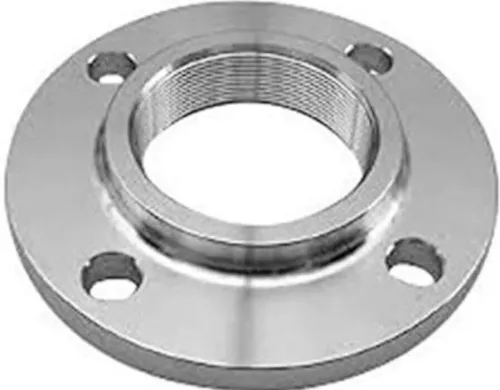

A standard stainless-steel threaded flange can cost roughly ₹150 to ₹4,500 per piece in common NPS 1/2 to 6 sizes, while 316L versions can reach ₹6,500 before GST, freight and inspection charges. By separating size, pressure class, alloy, thread standard and certification, you can compare Ankleshwar quotations without treating unlike products as competing prices.
Key takeaways
- Budget ₹150–₹4,500 for a standard Class 150 stainless-steel threaded flange.
- Treat ₹150–₹4,500 as a small-quantity estimate, not a verified quotation.
- Compare grade, pressure class, size, standards, documents, GST and freight line by line.
- Reject a low price that omits inspection records, traceability or required machining.
What budget should you set for a standard threaded flange?
Set ₹150–₹4,500 per piece for a standard ASME Class 150 stainless-steel threaded flange bought from an Ankleshwar supplier. These are working budget figures for small quantities, not verified market quotations; GST, freight, inspection documents and special machining can increase the invoice.
| Nominal size | Practical budget per piece |
|---|---|
| NPS 1/2–1 inch | ₹150–₹400 |
| NPS 1-1/2–2 inch | ₹250–₹800 |
| NPS 2-1/2–4 inch | ₹700–₹1,800 |
| NPS 6 inch | ₹1,800–₹4,500 |
For 304L, an allowance of roughly ₹150–₹4,500 across NPS 1/2–6 inch is realistic because size, pressure class and machining usually outweigh the small-grade difference on standard items. A 316 or 316L quotation can be higher, so require the exact designation, such as ASTM A182 F316 or F316L, rather than accepting “SS316.”
Treat any online threaded flange price in Ankleshwar as incomplete until you confirm nominal size, Class 150 or 300, RF or FF face, thread standard, quantity and delivery terms. One-off pieces can include setup, packing and courier charges; full-size or mixed-size batches usually produce lower unit pricing.
Ask whether GST and freight are included, and request the heat number and material test certificate if traceability matters.
How much do 304L, 316 and 316L threaded flanges cost?
A 304L threaded flange price is usually close to 304 because forging, machining and handling dominate small orders. Allow roughly ₹150–₹4,500 per piece across 1/2–6 inch sizes; NPS, pressure class and quantity drive the spread.
| Grade | Price guide | What to verify |
|---|---|---|
| 304L | Baseline; about ₹150–₹4,500 | ASTM A182 F304L, if the purchase requires low-carbon chemistry |
| 316 | Usually 25–60% above comparable 304/304L | Whether “316” means ASTM A182 F316 or generic SS316 |
| 316L | Usually 25–60% above comparable 304/304L | ASTM A182 F316L, heat traceability and certificate scope |
For budgeting, a 316l threaded flange price is about ₹200–₹700 for 1/2–1 inch, ₹350–₹1,200 for 1-1/2–2 inch, ₹900–₹2,700 for 2-1/2–4 inch and ₹2,500–₹6,500 for 6 inch, before site-specific delivery and GST. Small quantities, PMI and full traceability widen the premium.
Do not treat 316 and 316L as interchangeable. 316L limits carbon to about 0.03%, compared with about 0.08% for conventional 316; that difference supports welded fabrication and reduces sensitisation risk, but does not automatically make an unwelded flange stronger.
Require these items on the quotation:
- NPS, Class 150 or 300, RF or FF, thread standard and quantity
- ASTM designation, heat number, MTC and PMI requirement
- GST status and delivery-to-site charges
- Confirmation of clean internal threads, correct bore depth, concentricity, thickness, flatness and permanent marking
A damaged sealing face or re-tapping requirement can erase any alloy-rate saving.
Which specifications make one quotation cost more than another?
A Class 300 threaded flange usually costs about 20–50% more than a Class 150 equivalent because it needs more metal, greater thickness, different bolt dimensions and additional machining. Class 600 and higher require a separate quotation; do not estimate them by adding a small percentage to a Class 150 price.
| Specification | Lower-cost comparison | What raises the quotation | What to verify |
|---|---|---|---|
| NPS and dimensions | Smaller nominal pipe size, standard thickness | Larger NPS, thicker hub or flange, larger bolt circle and heavier weight | NPS, outside diameter, thickness, bore and bolt-hole details |
| Pressure class | Class 150 | Class 300, 600 or higher | ASME B16.5 class and pressure-temperature rating |
| Thread form | Standard NPT production | NPT versus BSPT or another specified form, special pitch or tighter inspection | Internal thread standard, size, pitch and usable depth |
| Face type | Flat face (FF) | Raised face (RF), specified finish or tighter flatness | RF or FF, face finish and sealing-face condition |
| Material and standard | Standard 304L or 316L line item | ASTM A182 forging requirement, PMI, MTC or additional testing | Grade, ASTM A182 designation and documents included |
The thread standard must appear separately from the flange standard. “ASME flange” does not prove that the bore is NPT: request ASME B16.5 for dimensions and class, plus ASME B1.20.1 when NPT is required. Compare identical NPS, class, face, grade, quantity, certification, GST and delivery terms.
A cheaper flange with damaged threads, poor concentricity or an incorrect bore can cost more through rework.
What must an Ankleshwar supplier include in the quotation?
Request one priced line for one exact item, not “stainless threaded flange.” State NPS, pressure class, facing, thread form, material designation, quantity and delivery location. Whether you approach Chirag Steel or another Ankleshwar source, use the same specification sheet so a lower unit price does not hide missing certificates, freight or machining.
- Commercial terms: price per piece, quantity-break prices, minimum order, GST rate, freight, packing, courier charges, payment terms, validity and delivery date.
- Technical details: NPS, Class 150 or 300, RF or FF face, ASME B16.5 dimensions, ASME B1.20.1 NPT thread, thread orientation, surface finish and any special machining.
- Material records: ASTM A182 F304L, F316 or F316L designation, forging or machined-plate route, heat number and country of origin.
- Certification: EN 10204 3.1 material test certificate, chemical and mechanical results, dimensional inspection report and PMI report when specified.
| Quote wording | Acceptable like-for-like wording | Why it matters |
|---|---|---|
| “316 threaded flange” | ASTM A182 F316, NPS 2, Class 150, NPT | “316” alone does not identify the product standard or thread. |
| “ASME flange” | ASME B16.5 dimensions with ASME B1.20.1 NPT thread | ASME B16.5 does not prove the internal thread form. |
| Certificate included | EN 10204 3.1 MTC stating heat number and F316L chemistry | A generic certificate cannot link the material to your batch. |
| Delivered price | Unit price plus GST, freight to site and delivery date | Extras can erase an apparent saving. |
When is the lowest threaded-flange price a false saving?
A low quote becomes a false saving when the flange cannot be installed without re-tapping, facing or replacing it. The question “what do stainless steel threaded flanges cost from Ankleshwar suppliers” matters only after you confirm that every quote describes the same usable component.
Before placing the order, check these points:
1. Match the thread exactly: NPT to ASME B1.20.1, or BSPT/BSPP to the specified standard. A flange with the wrong pitch or taper will not seal on the pipe, even when its outside dimensions look correct.
2. Require the material designation, not only “SS316” or “316L”. Ask for ASTM A182 F316 or F316L, the heat number and an EN 10204 3.1 certificate. Without traceability, a low alloy price can hide an unsuitable material.
3. Confirm NPS, ASME B16.5 pressure class, flange thickness, bore depth and face type. A Class 150 flange is not an acceptable substitute for a Class 300 connection because the price is lower.
4. Request evidence of clean, undamaged internal threads, a flat sealing face, concentric bore and legible marking. Damaged threads or a warped face create leakage, rework and installation delays.
5. Add GST, freight, inspection, PMI, certification and minimum-order charges to the comparison. A cheap unit price can exceed a complete quotation after these extras appear.
Threaded flanges also deserve a pressure-temperature and cyclic-service review. Avoid them where the connection is leakage-critical or exposed to severe vibration unless the design engineer has approved the arrangement.
Frequently asked questions
What budget should you set for a standard threaded flange?
Set ₹150–₹4,500 per piece for a standard ASME Class 150 stainless-steel threaded flange in a small quantity. Add GST, freight, inspection documents and special machining when they are not included.
How much do 304L, 316 and 316L threaded flanges cost?
The quotation depends on grade, size, pressure class, quantity, standards and documentation. Ask the supplier to price 304L, 316 and 316L separately because the material grade changes the comparison.
Which specifications make one quotation cost more than another?
Compare nominal pipe size, ASME pressure class, flange standard, stainless-steel grade, thread details, machining, quantity, inspection requirements and required certificates.
What must an Ankleshwar supplier include in the quotation?
Request the per-piece price, grade, size, pressure class, applicable standard, quantity basis, GST, freight, delivery time, payment terms, inspection documents and any machining charges.
When is the lowest threaded-flange price a false saving?
A low price is a false saving when it excludes GST, freight, inspection records, material traceability or machining required for installation. Compare the complete delivered and documented cost.