A repair can fail even when the replacement flange has the same nominal pipe size and pressure class, because neck length, bore, bolt pattern, weld location and installation clearance also control fit and performance. By the end, you will be able to identify the existing flange, decide between an LWN and a conventional weld neck, and prepare a replacement specification that fabricators and inspectors can verify.
Key takeaways
- Choose neck length from the installed pipe layout, not the catalogue label.
- Measure flange face, bolt circle, bore and neck dimensions before ordering.
- Confirm ASME B16.5 or B16.47 before treating flanges as interchangeable.
- Specify material grade, welding procedure, heat input and inspection requirements.
How the two flange geometries change the repair
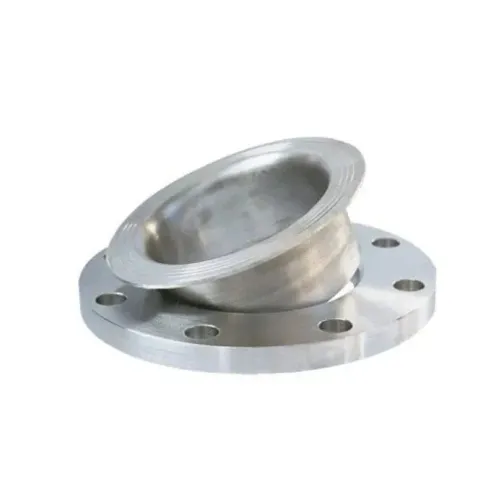
A standard weld neck flange has a tapered hub that ends at a butt-weld connection to the pipe. A long weldneck flange (LWN) carries that neck substantially farther from the flange face, acting more like an integrated standpipe or nozzle neck.
| Feature | Standard weld neck flange | Long weldneck flange |
|---|---|---|
| Neck geometry | Short tapered hub with a conventional face-to-weld dimension | Extended hub or neck with a much longer face-to-weld dimension |
| Load path | Transfers pressure, axial force, bending and thermal loads into the pipe near the flange | Moves the butt weld farther from a vessel wall, shell discontinuity or high-temperature zone |
| Repair effect | Fits conventional pipe spools and needs less installation length | Provides more alignment length and projection, but can create a larger cantilever and support load |
| Typical constraint | Limited separation from the flange face | Requires clearance for the extended neck, insulation and welding access |
The longer neck does not automatically reduce stress. It can improve the transition into a vessel nozzle or thicker component, yet its added length can increase bending if the connection lacks support.
Confirm the bore, pipe-wall match, flange face and weld location against the existing spool rather than comparing Class 150, 300 or 600 alone; pressure-temperature ratings depend on material, governing standard and design conditions.
For a stainless steel long weldneck flange comparison, treat the neck length as a load-path and fit-up dimension, not merely a catalogue variation.
A conventional weld neck is the wrong replacement if moving the weld defeats nozzle projection or insulation clearance; an LWN is wrong if its extension interferes with valves, supports or a congested spool.
Choose the neck length from the existing installation, not the catalogue name
Choose the geometry that reproduces the installed face-to-weld dimension and clears the surrounding hardware; do not choose by catalogue label alone. For a long weldneck flange replacement in Bengaluru, compare the spool isometric with the installation envelope before ordering. Check insulation, pipe shoes, supports, valves, vessel nozzles, adjacent welds and available straight-pipe length.
| Option | Select it when | Reject it when |
|---|---|---|
| Long weldneck flange | The flange must project through thick insulation, connect to a vessel or exchanger nozzle, move the butt weld away from a shell discontinuity, or provide the required nozzle projection and alignment length. | The extended neck hits a support, valve, pipe shoe or insulation boundary, or shifts the flange face beyond the mating connection. |
| Weld neck flange | The existing spool uses the shorter face-to-weld dimension and the repair has enough straight pipe for butt welding, alignment and insulation clearance. | Its shorter neck removes a required projection, places the weld in a high-temperature or inaccessible zone, or defeats the original stress or nozzle design. |
A weld neck flange can replace an LWN only after you confirm nozzle projection, weld access, bore alignment and the stress calculation. The reverse substitution also needs checking: an LWN is not a drop-in replacement when its extra length changes support loads or causes interference.
Treat the longer neck as useful geometry, not extra safety. State design pressure and temperature, cyclic service, insulation thickness and the governing drawing; pressure Class 150, 300 or 600 alone cannot approve the substitution.
Measure the flange before you order a replacement
Measure from the flange face to the butt-weld location, not only across the flange ring. That single dimension usually distinguishes an LWN from a standard weld neck flange: an LWN places the weld substantially farther from the face. Record the existing neck outside diameter, bore, taper or transition profile, and total face-to-end length before removal.
| Measurement | Long weldneck flange | Standard weld neck flange |
|---|---|---|
| Face-to-weld length | Extended; check nozzle projection and clearance | Shorter tapered hub; check spool replacement length |
| Neck outside diameter and profile | Long, often nozzle-like transition | Tapered hub transitioning into the pipe |
| Bore | Must match pipe or nozzle inside diameter | Must match pipe or nozzle inside diameter |
| Flange outside diameter and bolt circle | Confirm against the existing flange | Confirm against the existing flange |
| Bolt holes | Count, diameter, and orientation must match | Count, diameter, and orientation must match |
| Face | Raised-face diameter and height, or other facing, must match | Same checks; nominal size alone proves nothing |
- Measure the outside diameter, bolt-circle diameter, hole count, hole diameter, and flange thickness.
- Measure the bore at the flange face and at the pipe side; a mismatch can create an internal step.
- Check the gasket seat, bolt access, insulation thickness, nearby supports, valve body, pipe shoes, and adjacent welds.
- Compare the total replacement length with the spool isometric and installation envelope. An LWN that matches the bolts can still prevent alignment or create interference. Request a dimensioned drawing showing every recorded value before release.
Confirm the governing standard and interchangeability limits
A matching NPS and Class do not establish interchangeability. Confirm the governing dimensional standard first: ASME B16.5 covers many stainless-steel flanges through NPS 24, while ASME B16.47 covers NPS 26 through NPS 60. A fabricated or extended long weldneck design also needs the approved manufacturer drawing and project specification.
| Reference | What it controls | Interchangeability limit |
|---|---|---|
| ASME B16.5 | Dimensions and pressure-temperature ratings through NPS 24 | Use the correct material group, facing and pressure class |
| ASME B16.47 | Large-diameter flange dimensions for NPS 26–60 | Do not substitute it for B16.5 |
| Manufacturer or project drawing | Extended neck, transition, bore and overall length | Governs when the geometry is nonstandard |
Before release, compare the replacement against the existing flange or controlled drawing:
- Outside diameter, bolt-circle diameter, bolt-hole count, hole diameter and raised-face diameter, height and finish
- Bore diameter, neck outside diameter, overall face-to-weld length and transition profile
- Facing type, flange thickness, gasket dimensions and bolt clearance
- Weld location, nozzle projection, insulation clearance, supports and access for welding
- Design pressure and temperature, including derating for elevated temperature, corrosion or cyclic loading
A conventional weld neck is interchangeable with an LWN only after these checks confirm that the shorter neck does not invalidate the original load path or layout. An LWN fails the fit check if its extended hub interferes with alignment, insulation, supports or adjacent equipment.
Specify material, welding controls and inspection for the repair
Require a traceable repair package, not merely a “304L flange.” For stainless steel long weldneck flanges versus weld neck flanges in Bengaluru, state the design pressure and temperature, NPS, ASME B16.5 or ASME B16.47 basis, pressure class, facing, bore, neck dimensions and drawing revision.
An extended or fabricated LWN also needs a supplier drawing approved against the existing spool or nozzle.
- Specify ASTM A182/A182M F304L forging, including the required heat treatment and pressure-temperature rating. The grade alone does not define face finish, bore, dimensions or chloride-service suitability.
- Require a material test certificate showing F304L, chemical and mechanical results, applicable standard and the actual heat number marked on the flange.
- Put the welding procedure, qualified welders, filler metal and purge gas in the inspection plan. For 304L-to-304L work, confirm the qualified WPS and filler selection rather than accepting a shop default; control interpass temperature and remove heat tint after welding.
- Require dimensional inspection for bolt-hole layout, outside diameter, thickness, bore, face finish and face-to-weld length. Compare the signed report with the approved drawing.
- Define visual examination and liquid penetrant testing for accessible stainless surfaces, plus radiography or ultrasonic testing of the butt weld when the piping class or engineer requires it.
- Add positive material identification at receipt and after fabrication where project controls demand it.
For stainless steel 304L flanges in Bengaluru, ask suppliers such as Chirag Steel to quote these documents and hold points explicitly. A Class 300 stamp without the material group and design temperature is not a complete repair specification.
Related products
 | Stainless Steel Flanges Manufacturer of ASTM A182 F304L Slip on and WNRF Flanges in India Stainless Steel 304L Flanges 304L Stainless Steel Flanges are made up of 304L... View product → |
 | Stainless Steel Flanges PED Steel Flanges / Weld Neck Flanges / ASTM A 182 Stainless Steel WNRF Flanges,Din Standard Flanges; DIN... View product → |
Frequently asked questions
How does a long weldneck flange differ from a standard weld neck flange during repairs?
A standard weld neck flange has a tapered hub that ends at the pipe butt-weld. A long weldneck flange extends the neck farther and can replace part of a standpipe or nozzle neck, changing fit-up, weld location and available clearance.
How do I choose between a long weldneck flange and a weld neck flange?
Match the replacement to the existing installation. Check the distance from the flange face to the weld, adjacent equipment clearance, pipe bore, wall thickness and the function of the extended neck before selecting either geometry.
What should I measure before ordering a replacement flange?
Record the flange outside diameter, raised-face or flat-face details, bolt-hole count and diameter, bolt-circle diameter, bore, hub diameter, neck length, weld-end outside diameter and wall thickness.
Which standards and material details must I confirm for a stainless steel flange repair?
Confirm the pressure class and governing dimensional standard, such as ASME B16.5 or ASME B16.47, then verify the material specification, grade, welding procedure, welder qualification, heat control and required inspection documents.